Kathy Maister's Start Cooking
VIDEOBLOGBROWSESEARCH

Sausage and Egg CasseroleMixed Bean and Vegetable SoupRoasted ChickenEnglish Muffin PizzasVegetable and Chef SaladChicken CutletsBaked Cod and Microwave SalmonSanta Fe Chili
Apple Snack AttackChicken Salad with Wild Rice (Classics)Potato Salad (Classics)Tomato Sauce RecipeGuy Kawasaki's Famous Teriyaki SauceChocolate Chip CookiesThree Good Kitchen KnivesHow to Make Fried Rice
Preparing GarlicOmelet with CheeseCutting an OnionGrilled Cheese SandwichHow to Fry an EggChocolate Chip PancakesCrack and Separate an EggChocolate Fudge Brownies

How to Buy and Store Ground Beef

posted in Meat, Poultry and Seafood by Kathy Maister

There must be at least 10 million different ways to cook ground beef!

I will be showing you how to make Chili, English Muffin Pizzas, and Spaghetti Sauce, just three recipes that start with ground beef.

Chili Anyone?

But first, a little bit about buying ground beef.

The first thing you will notice when you go to the meat section of your grocery store is that there are a wide variety of different packages of what all looks like ground beef, but with different prices. In most cases, the pricing is directly related to different levels of fat content. Generally, the lower the fat content, the higher the cost will be per pound. The fat content is indicated by the numbers on the package.
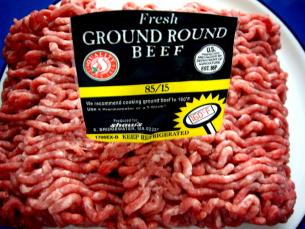
I usually buy what’s called 85/15, which is the ratio of beef — in this case, 85 percent — to fat, which is 15 percent here. This ratio gives me the taste and texture I like when I’m cooking.

Many people who are watching their fat intake buy 90/10. I find that ratio to be a bit dry, but each to his own! (My trick is to use the 85/15 beef, but drain off the fat after I have browned the beef.)

You should use or freeze ground beef within 2 days of buying it. If you are going to freeze the beef, put an extra layer of plastic wrap around the package to protect it from “freezer burn.”

If meat (or bread or even ice cream) has been in the freezer too long, the food gets very dried out and develops white edges. It not only looks awful but the taste and texture will be pretty bad as well.

Another “must” before freezing, is to label and date the package. You’d be amazed at how long unmarked packages take up residence in the freezer!

Frozen ground beef should be used within four months of purchase. After that, I’d definitely recommend throwing it away!

Stay tuned for how to brown ground beef, how to thaw ground beef, and of course, please take a look at our great beef stew recipe.

If you are new to startcooking, or are a regular visitor here, please consider subscribing for free.

subscribe

13 comments

Graydon | posted on Sep 14, 2006

One thing on freezing ground beef.  I've always taken the meat out of the original packaging and place in a freezer zip-lock making sure to squeeze out all / as much of the air as possible and then forming down as flat as possible.

This helps if you don't always wrap it twice as you suggest but the key benefit is that it thaws much faster (greater exposed surface)... and in a pinch, you can start browning the beef while still a bit frozen in the middle by starting on a lower heat.

Your picture seems to show the packaging like I said, but thought it would be worth pointing out directly.

Kathy Maister | posted on Sep 14, 2006

Thanks Graydon for the tip!  Squeezing the air out of the bag makes a lot of sense.  My grocery store sells beef in Styrofoam containers which take up too much space in the freezer, so I tend to rewrap the beef.  (Otherwise there isn’t enough room for ice cream!)

Kathleen OBrien Thompson | posted on Sep 15, 2006

Greetings Kathy- Sensational Site! The company I work with has worked in support of your husband for years and in reading his blog, I saw this site and knew I had to check it out...I too have a passion for cooking...In fact, a few years ago, I was doing in person classes for many of my girlfriends who didn't know the basics of cooking. What a terrific idea to bring it to a larger audience, Congratulations! The other element I added was how to do it quickly and cost effectively (The girls were fresh out of college and had small amounts of time or money, and even smaller skills!) In any case, my comment or question has more to do with a recent article I read about many supermarkets that were using carbon monoxide to keep the meat looking red, even after it had already gone bad. I was horrified by this knowledge and the fact that the FDA has not outlawed this practice. I do recall there was a lawsuit by one major grocery chain that does not use the practice, Kroger, who was trying to get this unsafe practice, made illegal. The suggestion made in the article was to go more by date than look of the meat, but that the best way to avoid the problem all together was to ask the butcher to ground fresh meat for you. You can ask at the counter, do your shopping and go back for it. Unfortunately, I don't have the article name or location, but perhaps you can find it, a likely source would be msn.com. Again, congratulations and I love the clear pictures, this is so much more useful and accessible than a TV show.

Lydia | posted on Sep 20, 2006

It's absolutely critical to remove any meat from the supermarket packaging right away, unless you are using it the instant you get it home, to avoid contamination and spoilage. Rewrap in clean plastic wrap or ziploc bags (and date, as you suggest) and seal before freezing.

BOFH | posted on Nov 1, 2007

I find the best thing to do is split the meat up into single/double serving then put a serving into a zip-lock freezer bag and smash it into a thin flat slab. Is best to get it all the way into the bottom corners and lest about 10-20mm free at the top.

Now seal the bag making sure not to trap to much air. This will make it easier and faster to de-frost (in a black water is best) and take up less relative space in the freezer.


Ethylene | posted on Feb 17, 2008

I'm interested in more information that is noted in a prior post about stores putting carbon monxide into meat to keep it red. Last night I bought some lean ground beef at a local store. It looked bright red, freshly ground and I wanted to cook a hamburger. I brought it home and found that actually only the outter layer of beef was red, and inside was some brown old looking groud beef. I took it back this morning, ready to shove it in the owners face. I ended up with a manager of some sort, who tried to convince me that when oxygen hit the meat that is what made it red, and that oxygen just hadn't gotten to the inside meat. I grew up on a farm and we processed our own meat. I had never heard of such. Meat getting brown to me has always been a sign of aging....and perhaps spoilage. I got a refund and do not intend to shop there again. If one will lie about one thing...or be deceitful, whatelse might they deceive you about? I suspect they are using the process that you mentioned earlier. I will now have to drive about 20 miles to another store.

Kathy Maister | posted on Feb 18, 2008

Ethylene,  According to the USDA:

"Why is pre-packaged ground beef red on the outside and sometimes dull, grayish-brown inside?

Oxygen from the air reacts with meat pigments to form a bright red color which is usually seen on the surface of meat purchased in the supermarket. The pigment responsible for the red color in meat is oxymyoglobin, a substance found in all warm-blooded animals. Fresh cut meat is purplish in color. The interior of the meat may be grayish brown due to lack of oxygen; however, if all the meat in the package has turned gray or brown, it may be beginning to spoil."
I think Kathleen's suggestion makes a lot of sense and may save you a very long drive to another grocery store:  "the best way to avoid the problem all together was to ask the butcher to ground fresh meat for you. You can ask at the counter, do your shopping and go back for it"
Good Luck!

Somi | posted on Apr 29, 2008

I am obsessed with washing meat before cooking, especially Ground beef, since it has so much visible blood. sometimes i spend a whole half hour just rinsing a single pound of beef again and again through a strainer until its white. it takes lot of effort and time. can someone please tell me an easier way to wash ground beef. i hear that a vast majority does not wash it at all.

please help

Kathy Maister | posted on May 2, 2008

Somi, it is not necessary to wash ground beef before cooking it.   Some people rinse it after it is cooked in order to rinse off excess fat.     

Julie | posted on Jun 23, 2008

I have a lot of great recipes that call for ground beef.  However, when I brown ground beef in a skillet, my kitchen and house smell like a wet dog!  Any way to brown ground beef without such a strong smell?  Thanks!

Kathy Maister | posted on Jun 25, 2008

Hi Julie, the best suggestion I can come up with is to be sure to run the exhaust fan over the stove.  You might want to also have a separate fan running to push the odors out the window.  

JC | posted on Jun 30, 2008

I am shocked after have read Ethylene's comment. This made me to comment her comment.

(Read her full comment above posted on Feb 17, 2008)

Ethylene claimed that "I grew up on a farm and we processed our own meat." which seems like she should know more about meat and processing of meat than most of us. Apparently, she knows nothing about meat or has not learned anything about meat while growing up in her farm. Before she rudely returned her ground beef, she could have smell the meat. Bad or spoiled meat have a definite smell that can easily be distinquished from fresh meat.

I think after Ethylene had read the link to the USDA article, she should have gone back to the local store where she had purchased the meat and appologize to the person she had accused of lying or deceiting her. The person who she spoke to really knows his/her stuff and I could almost guarantee you that he/she did not grow up on a farm!

Ethylene, just by reading that one article regarding carbon monoxide used in spoil meat, you have reacted foolishly and irrationally. If you don't believe the so-called manager, talk to the butcher or meat handler in that store. Don't try to play 'get smart' if you don't know anything about air and food chemical reaction. Since you won't be shopping at that store again, I am glad that the store don't have to deal with a customer like you. If I were that manager who you had spoke to, I would double the refund to you and tell you to never shop here again. Go 20 miles to get your meat is another bad move. You must be paying $1.99 per gallon for gas!! (in your delusional thinking).

I wonder if this is the first time Ethylene have ever purchased ground beef or any meat for that matter. Look at the steak or any cut you buy, same appearance, bright red on top and slightly brownish other side, unless the butcher has just cut and put out the meat which would be redish or somewhat brownish when it is fresh, not bright red as it has been in contact with air for a day or two.

What do you all think ??

steve | posted on Aug 5, 2008

Generally, asking simple questions whenever you have a concern and noting whether the person answers them without evasion is sufficient.  Maybe there was something about the meat manager's response that made her suspicious.

Although, I tend to think she overreacted.

My understanding of this issue is as follows and is not gospel:

Smell, appearance, and labeling are all factors in determining the freshness of meat.  '

The simplest way to get the answer is to just ask the butcher or manager, "when was this meat ground?  Can you tell from the label?"

Hemoglobin in the meat will react with oxygen to make the "red" color.  Of course, eventually the red color will give way to other colors as the meat gets older and, eventually, spoils.

Carbon monoxide binds with hemoglobin in the same way, yet doesn't oxidize the same way as oxygen, so the red color stays longer.

My understanding is that The Carbon monoxide treatment is usually only used at big meat plants, as it is deadly poisonous to breath fin its free form or people and needs special equipment to apply is safely.  It is not unsafe to eat once it is "bound" to the hemoglobin in the meat.

Meat that has been ground in the store and stored in normal plastic wrap with styrofoam is not going to be CO-treated by the store.  It is possible that it could have been ground at the store from CO- treated meat, however, but highly unlikely.  CO treatments are more for packaging meat in individual portions for consumer purchase, not for delivery as large cuts to a store.

anything in CO treatment will be presented in a thicker plastic that is vacuum and heat-sealed as well.


Post a Comment

Note: This blog uses a 2-click comment system to combat spam. After you submit your comment below, you will be prompted to click a second button to complete the posting process.

Name

Email

Website/blog

Your Comment:

 Send me an email when other people comment on this post


0 trackbacks

Trackback URL:

http://startcooking.com/trackback.php?id=59


Fresh Funds

Get startcooking for Free

Are you a busy person who just never got around to learning the basics of cooking? We built startcooking.com just for you. You'll learn how to make quick and tasty meals, plus learn the basic cooking skills you'll need. Get ready to start cooking!

how do I use this?

Browse Posts


How to Mince, Dice and Chop OnionsHow to Buy and Store OnionsCutting Boards
BLT SandwichBrowning Ground BeefHow to Buy and Store Ground Beef
How to Cook Potatoes in a MicrowaveHow to Set a TableOven-Baked Potatoes


About Contact Kathy Commenting Policy Support Legal Press Kit Newsroom